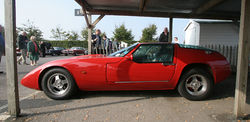
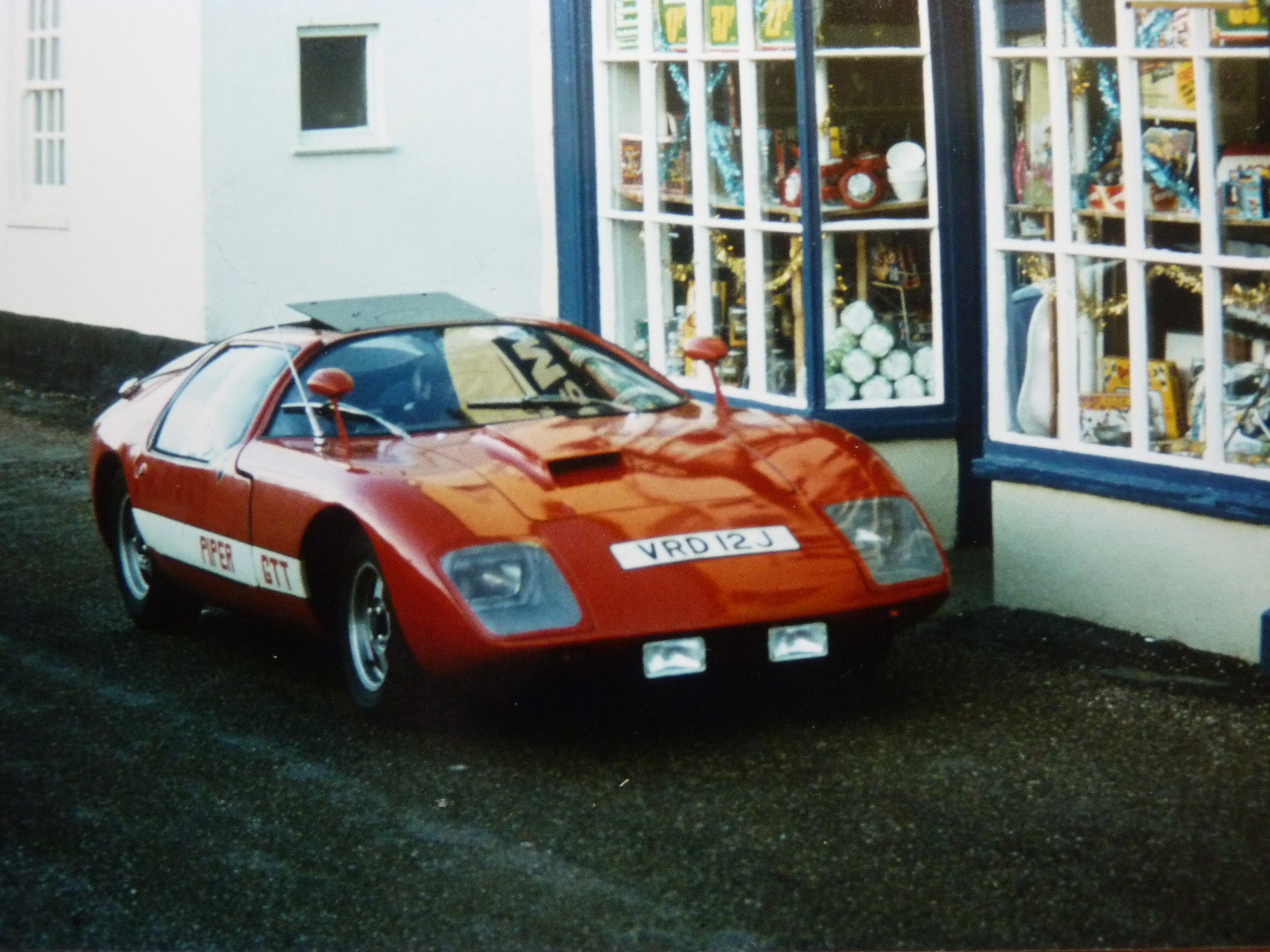
‘There’s something stirring in a Lincs village – at 120 mph’; so ran the story line to an article in the Lincolnshire Echo dated 12 November 1973 about Emmbrook Engineering of South Willingham.
Bill Atkinson and Tony Waller brought production of the Piper sports car to South Willingham in June 1973. The sleek sports car sported a fibreglass bodyshell attached to a square-section tubular steel chassis. Components were largely from the Ford parts bin, and the Phase Two iteration of the Piper line could be bought for around £2,200.
The pair settled in premises in the old station yard after searching for a suitable location in Lincolnshire. Bill Atkinson stated that, “it is just what we wanted – plenty of space and no interruptions. During the four months we have been here we have produced three cars.”
Production of Piper Sports Cars began in the south of England in 1968 and the first Piper GT road model, to a design by Tony Hilder, was introduced at the January 1967 Racing Car Show and immediately afterwards entered production as a body/chassis unit for home completion. These early cars were produced by Campbells Garage and were based on BMC ‘A’ Series components. Problems with the first few cars produced caused further production to be delayed until the following year, when, under the now-ownership of Brian Sherwood, Piper Cars introduced a substantially better developed version which became known as the GTT. Following the death of company owner Brian Sherwood in 1969 Bill and Tony stepped in and began focusing on improving the road-going version of the Piper sportscar (there was a pure competition version too). Bill Atkinson has kindly provided further background information to Piper Sports Cars and how they came to be produced at South Willingham.
I started as a customer when I went down to Wokingham in Berkshire from my home in the North East to look at a Piper GTT sometime towards the end of 1968. I placed an order and collected my car in early 1969. It was on my visit to the factory that I first met Tony, who was the Company Secretary.
After taking delivery of the car, I made what I believed to be a number of improvements. Brian Sherwood was suitably impressed and, in September 1969, offered me the job of factory manager. At this time we were still producing GTTs and GTR race cars.
Tragically, Brian Sherwood was killed in a road accident about three months after Bill started working for Pipers. Despite all the ‘uncertainties’ which this left, Bill and Tony somehow managed to keep the company going; the Piper Car Company basically died with Brian, and the new company became Emmbrook Engineering, the name taken from the district of the town. Ford engines with modified heads and Piper cams produced the motive power for the cars and in 1971 a further revision known as the Piper P2 (Phase Two) began production and included many improvements to chassis, body and interior design. A six-inch increase in the overall length, twin round headlamps, modified tail lights, modifications to the rear suspension and a slightly wider track were amongst the improvements introduced on the P2. This model continued in production until the mid-1970s, and was the design Bill and Tony brought to South Willingham.
The move to South Willingham was precipitated by a belief that the premises in Wokingham were due to be developed, and real estate in Berkshire was not cheap. The possibility of a move to Lincolnshire had actually occurred around Easter 1971; Bill Atkinson takes up the story:
Tony and I were travelling up the A1 to deliver a Piper and, nearing Grantham, I remarked to Tony that the area looked very pleasant and that it might be a good place to live and work. As it happened, an aunt of Tony’s lived in the area and she sent down some local newspapers for us to browse. We somehow made contact with a chap who was involved with rural development and he put us on to an old mill at Dogdyke near Coningsby. We made plans to buy the mill, even though it needed a lot of work; however, around the end of 1972 the deal fell through. We then made contact with Mike Perkins from Market Rasen and he showed us some properties in the area. None were really satisfactory and I told Mike that what we really wanted was a nice big shed in the middle of a field, somewhere we could get on with our business unhindered.
Mike then took us to have a look at the building we occupy to this day; full of large sacks of sugar, and situated in the yard of the old railway station the building was owned by Ted Aldridge – it had formerly been built in the 1960s by the Fox & Garner sack hire company. Although not then for sale, Mike did persuade Ted to sell us the building and some land. George Hardy fenced off the land and later worked for us on general duties. George lived in a bungalow in South Willingham opposite Church Lane known as Braemar, though he had previously lived in Benniworth.
So, Bill and Tony moved Piper Car manufacture to South Willingham in June 1973, beginning production almost immediately. Bill recalls that of the few cars that were produced, most had already been started down at Wokingham, and barely a handful left the Emmbrook factory. Three production staff accompanied the pair to South Willingham but, for a variety of reasons, didn’t stay very long.
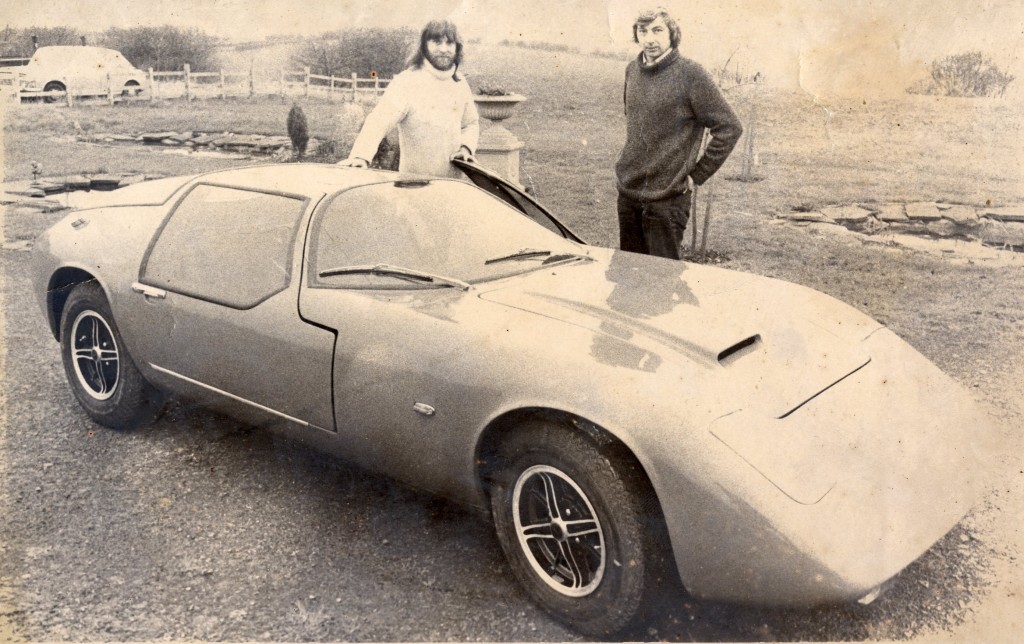
At the time the article appeared in the Echo, Emmbrook Engineering was said to have a four-month waiting list for its cars. However, changes in purchase tax duty and the fuel crisis led to a very premature end to car manufacture in South Willingham and, as indicated above, very few cars were actually produced. Estimates of total Piper production vary from around 80 (a figure produced by the Piper Sports and Racing Car Club) to somewhere over 100, so few cars can have been produced in the old station yard at South Willingham during those few months of late 1974 to mid-1975.

Even before the last Piper sports car left the factory, Bill and Tony had begun diversifying in order to survive, as Bill now relates:
A chap called Martin Knowles and an associate of his had read the article in the Lincolnshire Echo; they had been developing a corner bath and, reading that we were producing car bodies in fibreglass, came to see us. This resulted in us beginning to produce corner baths, which turned out to be very fortunate for us given the crisis with Piper car production. We also began making model boats for the well-known firm of model-makers, Keil Kraft. Not only this but, again in conjunction with Martin Knowles, we produced sailing dinghies and rowing dinghies. I also recollect that we were going to build a large thirty-foot boat for Mr Anderson, who lived in the old rectory at South Willingham at that time; however, I can’t remember to what stage we took this to but I don’t think we actually built the boat.

Later, we went into partnership with Joe Kingham from Doncaster (Joe had a shop in Lincoln) and Vic Butters from Hull, making baths; I believe we traded under the name of Laminated Glass Fibre Products when we formed this partnership. For some time we continued making for the trade, but after a while a customer asked if we could supply matching sanitary ware after buying one of our shower trays. This led us to start selling bathroom suites direct to the public as a retailer, rather than just supplying to the trade.

After surviving more than one recession, and nearly being ‘taken down’ by the various trade outlets we supplied to when they got info difficulties, we built a small showroom on the upper floor of the factory and ended up as a mainly retail business. Somewhere in this period we began to use the business name Marenda-Lindsey Ltd; in fact, we had this registered as a company name even before we left Wokingham, as we were already looking into diversifying, the name being a corruption of the Christian names of our then-wives (Mary and Brenda for myself and Tony respectively and, of course, we were shortly to move to new premises in East Lindsey). We stopped making baths, although we continued with the shower trays for some time and eventually added kitchen ranges to our core business of bathroom suites – and that is how the business is to this day.